Dental Implants – Bloomfield Hills, MI
Restore Your Beautiful Smile with Durable Dental Implants
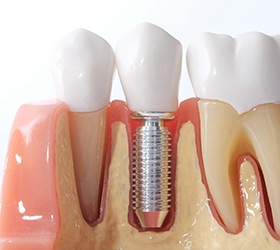
Even missing just one permanent tooth can take its toll on your oral and emotional health. Restorations like traditional dentures and bridges may solve the problem of restoring your smile, but these solutions don’t protect your gums and jawbones or permanently benefit your self-esteem. With dental implants, you can restore your teeth as well as the root structure which supports them, helping to protect your gums and jaw and strengthening your smile, restoring your confidence. To learn more about how dental implants can help you in Bloomfield Hills, schedule a consultation with Cranbrook Dental Care today, or visit our dental implant website for more information.
Why Choose Cranbrook Dental Care for Dental Implants?
- Entire procedure can be completed in-house
- Over 25 years of dental implant experience
- Dental insurance and in-house financing proudly accepted
What Are Dental Implants?
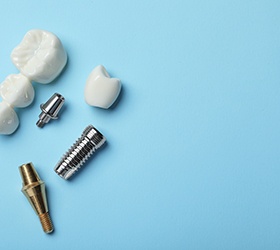
Dental implants are durable, natural-looking permanent tooth replacements. Each implant is comprised of three main parts: the implant, the abutment (where the crown sits), and the crown (the tooth). To get dental implants, your dentist surgically inserts the implant post into your jaw, where it fuses with the bone in a process known as osseointegration. Once secure, your dental implant acts as a replacement tooth, providing necessary stimulation to keep your jaw strong and healthy and protect any remaining natural teeth. Best of all, unlike dentures or dental bridges you won’t need to replace your dental implants, and unlike dentures they don’t need to be removed for cleaning or soaking, ensuring that you’ll never suffer embarrassing slips or denture sores. Plus, because they’re permanent, you’ll save money over time on replacement costs.
The 4 Step Dental Implant Process
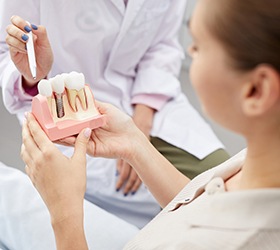
The dental implant treatment process involves four main steps: the initial consultation, implant surgery, recovery (and osseointegration), and delivery of your final crown, bridge, or denture. Rest assured, your implant dentist in Bloomfield Hills can go over each step with you in more detail and address any questions or concerns you may have. In the meantime, though, please feel free to look at the overview below and see how we can restore your smile with dental implants!
Initial Dental Implant Consultation
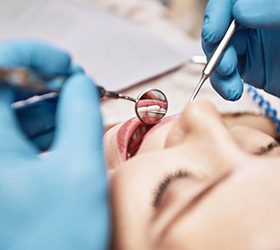
We want to help make sure your treatment will be successful and that you’re well-informed about your dental implant restoration. To that end, we’ll schedule a time for you to meet your implant dentist face-to-face. This will be your dental implant consultation, and during this appointment, your implant dentist will review your health history, perform an oral exam, and help you plan for any preliminary treatments or scheduling complications.
This is also a good opportunity to ask any questions in person, so you might find it helpful to take notes.
Dental Implant Surgery

After taking care of any oral health conditions like cavities, gum disease, and jawbone loss, your implant dentist will surgically place your implant posts. They’ll administer a local anesthetic and any requested dental sedation, make a small incision in your gumline, carefully anchor the implant post to your jawbone, then suture the incision closed.
It will be important to avoid disturbing the implant during post-op, and don’t worry – we’ll provide you with thorough recovery instructions.
Dental Implant Osseointegration & Abutment Placement
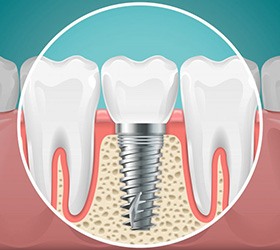
While you’re resting and recovering from dental implant surgery, your jawbone will be fusing with your implant post. This natural biological process is called “osseointegration,” and thanks to the biocompatible qualities of dental implant materials, it’s quite safe. Proper osseointegration will help ensure your final restoration stays in place and supports your smile.
In about four to six months, your jawbone and implant should be integrated enough that we can call you back to the office for your abutment – which is a small connecter piece that will allow your implant dentist to attach your final restoration to your implant posts.
Delivery of Dental Implant Restorations
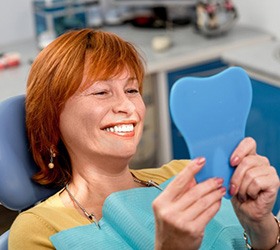
Finally, your implant dentist in Bloomfield Hills will provide you with your fully customized implant crown, bridge, or denture. Securing the restoration isn’t as involved as dental implant surgery, but our team can still administer dental sedation for anxious patients. Your implant dentist will check to make sure your restoration fits and functions properly, make any necessary adjustments, then send you on your way so you can enjoy your renewed smile!
Benefits of Dental Implants

There are many benefits to getting dental implants, especially when you compare them to other restoration options like dentures and dental bridges. We’ll discuss them in-depth during your consultation, but you’re also welcome to read on to learn a few noteworthy ones!
Day-to-Day Benefits

Here are a few of the benefits of dental implants that you’ll enjoy almost immediately:
- Easy Maintenance – Unlike other tooth-replacement solutions, dental implants are easy to maintain. Just take care of them with the same habits you use for your real teeth (i.e., brushing twice a day, wearing a mouthguard during sports, scheduling a checkup and cleaning every six months).
- Ability to Eat Your Favorite Foods – Like many other patients, you may have been forced to eat applesauce, yogurt, and other extremely soft foods on repeat following tooth loss. Fortunately, dental implants can restore some of the strength of your bite that you lost. As a result, you’ll be able to eat a much more satisfying diet.
- Improved Self-Esteem – In the weeks, months, and years after losing teeth, many patients lose their spark. If this sounds all too familiar, then you’ll be happy to hear that dental implants are extremely natural-looking. So, once they are securely in place, they won’t draw any unwanted attention to your smile.
Health Benefits

Dental implants also benefit your oral and overall health in several ways, such as:
- Prevents Dental Drift – As you may have guessed from the name, dental drift is when the teeth surrounding the gap begin to move out of place. Not only can this take a toll on your self-esteem, but it can also negatively impact the alignment of your bite considerably.
- Allows You to Eat a More Varied Diet – As we mentioned above, you won’t be limited to the same bland, boring foods. Instead, you’ll be able to eat a variety of nutrient-dense ones, which benefits your oral and overall health greatly.
- Helps Prevent Bone Loss – While other tooth-replacement solutions rest against the surrounding teeth or gums, dental implants are inserted directly into the jawbone. As a result, it gets stimulated each time you bite down, helping to prevent bone loss in the process.
Long-Term Benefits

Lastly, dental implants offer several long-term benefits, including:
- No Recurring Replacement Costs – While other tooth-replacement solutions, like dentures, usually need to be replaced every 5-7 years, dental implants can last for 30+ years with proper care and maintenance.
- Unmatched Stability – Many patients with traditional dentures deal with insecurities stemming from their restoration moving unexpectedly. Since dental implants are surgically inserted directly into the jawbone, you can talk, laugh, and chew with complete confidence.
- No Denture Sores – Another perk of having your replacement tooth or teeth inserted into your jawbone: no more denture sores. Your new and improved smile will feel as great as it looks!
Who Dental Implants Can Help

Whether you’re missing just one tooth or all of them, dental implants can help. To be a good candidate, you’ll need a strong jawbone, healthy gum tissue, and to be committed to caring for your smile. Once you qualify, we can plan what type of implant you need, depending on how many teeth you want to replace.
Missing a Single Tooth
If you’re missing just one tooth, there’s no need to alter your permanent teeth to get a dental bridge. Single dental implants can replace just one tooth and are much healthier than traditional bridges, both because they don’t require removing enamel from healthy abutment teeth to work, and because they provide important jawbone stimulation that bridges can’t.
Missing Multiple Teeth
If you’re missing multiple teeth, implant dentures and implant bridges can help. These prosthetics look like their removable counterparts, but secure in place permanently via dental implant posts. They offer many advantages over traditional restorations, such as a more secure hold, important jawbone stimulation, and easier care and maintenance.
Missing All Teeth
It used to be that if you were missing all your natural teeth, your only replacement option was dentures. Unfortunately, however, traditional dentures often leave a lot to be desired. Removable dentures can slip, become misshapen, become easily damaged, cause denture sores, are difficult to clean, and must be soaked overnight to prevent them from drying out. With implant dentures, you needn’t worry about any of those things. While there are some varieties that are removable for cleaning, these prosthetics still stay secure in your mouth while in use, and because they won’t dry out, you can keep them in your mouth even when you’re asleep.
Understanding the Cost of Dental Implants

The cost of your dental implant treatment is highly individualized because it depends on many factors, including if you need any preliminary procedures, how many teeth you’re replacing, the location of the dental implants within your mouth, the type of implants and prosthetic you need, etc. Dental implants are an amazing investment in your oral and overall health, and with proper care can potentially last for a lifetime. To learn more about how this procedure can benefit your smile and determine your final cost of treatment, please schedule a consultation with Cranbrook Dental Care today.